Safe Work Australia Releases 2026 Worker Exposure Survey Findings
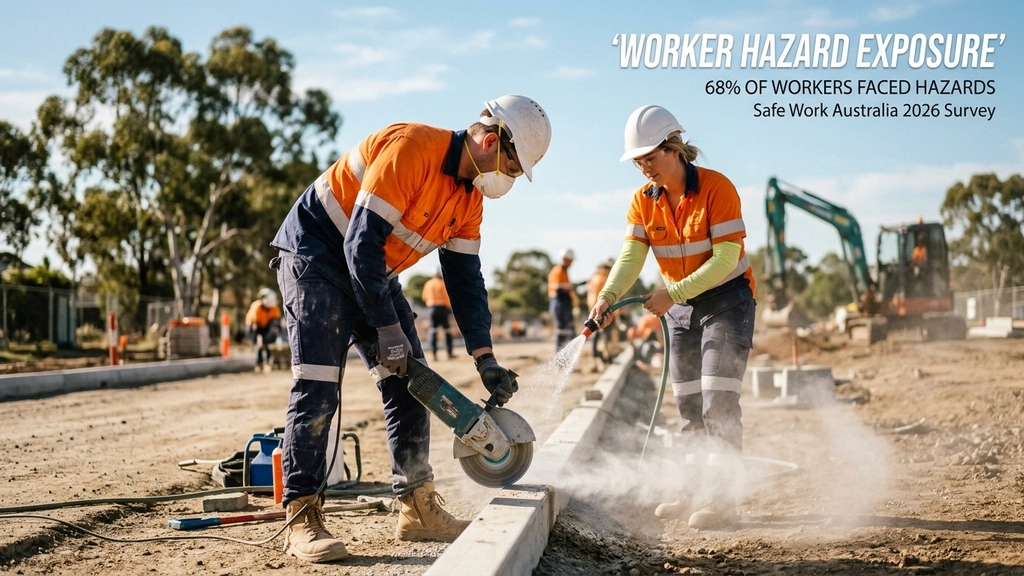
Safe Work Australia released its 2026 worker exposure survey, finding 68% of workers faced physical or chemical hazards, led by solar UV and silica.
The following is an abridgement of an article originally published by Safe Work Australia.
Survey Scope and Overview
Safe Work Australia published findings from the 2026 Australian Worker Exposure Survey, establishing national data on workplace exposure to physical, chemical, and psychosocial hazards.
Exposure to physical and chemical agents was calculated from worker-reported tasks, while psychosocial hazards were measured through self-reported work experiences.
Physical and Chemical Agent Exposures
The survey estimated that 68% of workers were exposed to at least one physical or chemical hazard, including 28.9% who experienced high-level exposure. Exposure to multiple physical or chemical hazards occurred most frequently in construction (68.2%), agriculture, forestry, and fishing (60.1%), and mining (60.0%).
Solar ultraviolet radiation was the most common hazard, with 32.4% of workers—approximately 4.87 million people—likely exposed, comprising 21.0% with medium-level exposure and 6.8% with high-level exposure.
Silica dust exposure was identified for 13.6% of the workforce, or roughly 2.04 million workers, with prevalence highest in construction (71.8%) and mining (63.8%).
The agency found that apprentices and trainees experienced higher exposure rates than other workers across several categories, including heat (51.1%), silica (35.7%), lead (17.0%), and asbestos (13.7%).
Psychosocial Hazard Findings
Widespread psychosocial hazards included cognitive demands, with 68.3% of workers reporting high concentration requirements and 37.3% reporting tight deadlines or pressure often or all of the time.
In measures of organizational agency and support, 21.8% of respondents disagreed that they have a say in workplace changes, 16.8% disagreed that they receive fair recognition, and 13.0% disagreed that they feel informed about workplace changes.
Safe Work Australia stated that the survey provides a baseline to track exposure trends as work practices evolve and to help target risk prevention initiatives.