The Work vs Home Safety Mindset
Why do we follow safety rules at work but ignore the same hazards at home? Discover habituation, optimism bias, and how home insights build better safety.

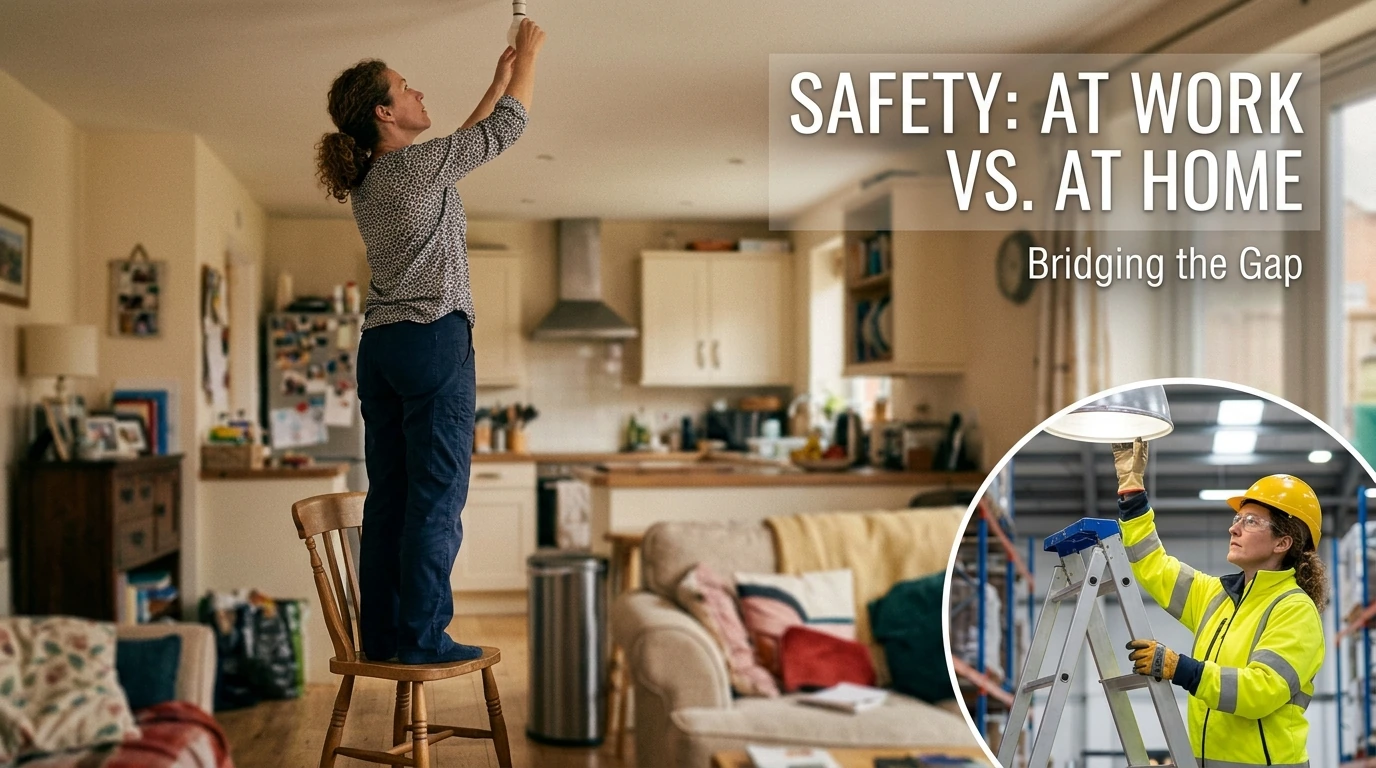
It’s 9 am at work and you’re greeted with a long power cord stretched across the hallway and your coworker using a wobbly chair as a ladder to drill a hole. You’re already dreading the meeting that’s going to be held about this.
When you get home at 5.30 pm you do the exact same thing yourself, without thinking twice.
Chances are you’re doing something daily that you’d balk at if you saw it at work: tripping over Lego, stepping over laundry piles, standing on a wobbly chair to reach something, or trying to move a piece of furniture that’s a little too heavy because you’re “not that old yet.”
So what changes between work and home? Why do we take safety seriously all day, only to switch off when we walk through the front door?
Are we too comfortable, optimistic, or just tired?
We often stop noticing hazards around our home because we see them every single day. That door? It’s been sticking for years. The overloaded powerboard hasn’t caused a problem yet, and that chair has always worked as a makeshift ladder.
Psychologists have a name for this: habituation. Habituation is when we react less to things we are used to seeing over and over again. It may cause us to overlook safety hazards simply because they have become familiar. Our homes feel safe and familiar, so our minds naturally switch off to an extent. The hazard hasn’t become safer, we’ve simply stopped noticing it.
Most of us can drive to work and barely remember the journey, yet pay much closer attention when driving somewhere unfamiliar.
People also naturally believe bad things happen to other people, not themselves. This well-studied psychological effect is called optimism bias. We don’t usually think:
"Maybe I need help moving this washing machine.”
Instead, we think:
"It’s only a metre or so."
Intelligent, capable people still take risks they would probably discourage someone else from taking because of this phenomenon.
If you spend the majority of your day checking hazards, completing SWMS, wearing appropriate PPE, carrying out risk assessments and solving problems, you can probably relate to wanting a break when you get home from work. One possible explanation is that, after making decisions all day, many of us simply switch to autopilot.
Decision fatigue is well recognised as an occupational safety hazard.
So why does it come more naturally at work?
Bringing a safety mindset home can feel difficult because it isn’t reinforced by procedures, regulations, and workplace expectations but relies on our own choices.
At work, safety isn’t just a personal responsibility. It is built into the environment around us. If a ladder is damaged, someone is likely to report it. At home, the same ladder might sit in the garage for weeks without anyone addressing it.
This is often referred to as a workplace's safety culture. There are procedures, signs, toolbox talks, readily available PPE, supervisors and colleagues who check in with us, and reminders to stop and think before acting.
Everyone shares responsibility for maintaining a safe workplace. Safety becomes part of how the work gets done, rather than a set of rules followed simply to avoid getting into trouble.
At home, many of those structures disappear, leaving us to rely on habit. Unfortunately, our habits aren’t always safe.
We can bring that same safety mindset home by:
- Making safety a personal priority for ourselves and our loved ones.
- Developing our own safety culture at home.
- Learning about common household hazards.
- Pausing to assess everyday tasks before getting started.
Pause for a second here. Did that last paragraph suddenly make you feel exasperated?
While you’re just trying to relax in your own house on the weekend, now you’ve got to worry about safety cultures and risk assessments at home too?
Hold on to that feeling.
Because that flash of frustration, tiredness, or inertia is the friction between ideal protocol and real life. It is exactly what frontline staff and colleagues experience every day when they are handed a new safety policy.
When on the clock, the rules are ingrained. But when it’s your weekend, your limited free time, and your own money required to buy the proper tools, perfect safety may suddenly feel like a big hurdle.
Let’s look at some common household hazards. But this time, instead of treating them as a lecture on how to behave in your own home, let’s explore why they happen at home and how that can inform workplace safety:
"I'll just use this chair" - Household falls
According to the Australian Institute of Health and Welfare, falls from ladders (or makeshift ladders) were the most common DIY injury during 2013–14, with more than 6,200 Australians hospitalised each year. Around 80% of those are men, mostly over 45.
The risk is real, no doubt. But let’s look at why you used the chair. Maybe the "approved equipment" was inconvenient, and you were trying to balance productivity (cooking dinner) with a time constraint.
Think about back in the workplace. When someone uses a bucket instead of a ladder, are they being careless? Or are they just trying to get the job done under pressure? If we keep the right equipment on hand (e.g. a folding step stool) in a convenient place, there’s going to be less effort in being safer on the clock and at home.
Still don’t think it will happen?
Consider Nick's story:
"…Nick decided to check a leaking roof, but he didn’t stabilise his ladder. He thought he’d be right and it wouldn’t take long. But halfway up, he fell. He sustained a brain bleed, a fractured back, pressure on his spinal nerves, and a blockage in an artery to his lung. Nick’s wife and son now care for him... He’s constantly worrying about whether he will get better."
You can watch the full video of Nick’s story here
Sensible, capable people take these risks at home all the time. Realising this helps us design safety systems at work that account for human nature,rather than just expecting consistent compliance.
"I'll move it later" - Trip hazards
Trip hazards are another common cause of falls and fall-related injuries in the home.
At work, housekeeping policies are strict on this. But experiencing that same fatigue at home helps you understand why staff might leave a stray cable across a walkway after a long day. Perfect housekeeping takes energy. Rather than just reporting it, this might prompt looking at whether there is enough time, energy and bandwidth in the workplace to maintain those standards. It’s the same for home, to stay safe we need to have the ability to housekeep and have easy places available to stow away tripping hazards with as little energy used as possible.
"It's not a big deal" - PPE
Many tradespeople, landscapers and gardeners wear long pants, gloves, long sleeves, helmets and steel-capped boots. They're protecting themselves from flying debris, heat, sharp objects and heavy equipment.
Buying a $200 pair of steel-capped boots, heavy-duty gloves, and safety glasses just for weekend yard work may feel like a dent in the personal budget. Not to mention, long heavy pants are hot and uncomfortable in the summer sun.
Suddenly, it’s a lot easier to understand the times workers have slipped off their safety glasses or complained about sweating in their high-vis long sleeves. When safety costs your own money and your own comfort, the compromises start to look tempting. Comfortable, well-fitting PPE and other comfort measures provided for workers is important, as is having affordable and comfortable alternatives at home.
Why does it matter?
Safety at home affects our wellbeing and the people around us. It also affects our work. An injury at home can mean medical treatment, unexpected expenses, time away from work and time away from the things we enjoy.
But the real goldmine here is bringing your home perspective back to work. Reflecting on why we leave our safety mindset at work really informs us of why things can go awry at work also.
The safest workplaces aren't necessarily the ones with the most rules or the harshest penalties. They're the ones where thinking about safety becomes part of how work gets done and safe choices are supported by management and the environment.
The next time there needs to be a new safety policy, remember the kitchen chair. Remember the lawn mowing thongs. Remember the exhaustion of stepping over the laundry basket.
If we can design safety protocols that acknowledge the realities of tired, budget-conscious, time-poor humans, we will do better than just making rules. There will be a safety system and culture that people actually want to follow.
References
Anderson,B. A., et al. Attention Failures Cause Workplace Accidents: Why Workers Ignore Hazards andWhat To Do About It. Policy Insights from the Behavioral and Brain Sciences. https://doi.org/10.1177/23727322231218190
Australian Institute of Health and Welfare. DIY injuries. https://www.aihw.gov.au/reports/injury/diy-injuries
Australian Institute of Health and Welfare. Injury in Australia. https://www.aihw.gov.au/reports/injury/injury-in-australia
Brain Injury Australia. Ladder Falls. https://www.braininjuryaustralia.org.au/ladder-falls/
Caponecchia,C. (2010). It Won't Happen to Me: An Investigation of Optimism Bias in Occupational Health and Safety. Journal of Applied Social Psychology. https://onlinelibrary.wiley.com/doi/10.1111/j.1559-1816.2010.00589.x
Cunningham,T. R., et al. Work-related Fatigue: A Hazard for Workers Experiencing Disproportionate Occupational Risks. American Journal of Industrial Medicine. https://doi.org/10.1002/ajim.23325
Injury Matters. Homesafety. https://www.injurymatters.org.au/programs/know-injury/evidence-bank/setting/home-safety/
Rankin,C. H., et al. Habituation Revisited: An Updated and Revised Description of the Behavioral Characteristics of Habituation. Neurobiology of Learning and Memory. https://doi.org/10.1016/j.nlm.2008.09.012
SafeWorkNSW. Building a health & safety culture. https://www.safework.nsw.gov.au/safety-starts-here/building-a-health-and-safety-culture
SafeWorkNSW. Safety starts here. https://www.safework.nsw.gov.au/safety-starts-here