Starting Safe: Giving Young Workers the Training and Experience They Need
Young workers need more than induction. Ongoing training, supervision and experience help build safer skills for the future.
.png)

Young workers are an important part of Australia’s workforce. They bring new skills, energy and perspectives into workplaces across almost every industry. Apprentices and trainees are also developing the technical knowledge and practical experience that businesses will rely on in the years ahead.
But starting work also means encountering tasks, equipment, environments and hazards that may be unfamiliar. Experience takes time to build.
A worker who has performed the same task for years may recognise an unusual noise, an unsafe shortcut or a changing condition almost instinctively. Someone performing that task for the first time cannot reasonably be expected to have developed the same practical judgement.
That does not make young workers the problem. It means workplaces have an important role in giving people the training, supervision, support and opportunity to build experience safely.
What the latest Australian data tells us
Recent Australian data highlights why this deserves attention.
Safe Work Australia’s 2026 Australian Worker Exposure Survey found that apprentices and trainees had comparatively high estimated exposure to a number of workplace hazards. This included heat at work at 51.1%, silica at 35.7%, lead at 17.0% and asbestos at 13.7%. Data Safe Work Australia
The survey involved more than 6,600 workers aged 15 and over and used information about the tasks people performed to estimate their likely workplace exposure to different hazards. Data Safe Work Australia
Other Safe Work Australia data also shows that workers under 25 experience a meaningful number of serious workers’ compensation claims. In 2021–22, workers under 25 recorded a serious claim frequency rate of 6.8 claims per million hours worked, although older age groups had higher rates overall. Data Safe Work Australia
The important point is not that being young automatically makes someone unsafe.
A more useful question is: Are workplaces giving people enough support while they develop the knowledge and experience needed to recognise and manage risk?
Experience cannot be delivered in an induction
Induction is important. It can introduce workers to workplace rules, emergency procedures, hazards, responsibilities and reporting processes. But an induction cannot replicate months or years of experience.
Practical safety knowledge develops over time through exposure to different situations, conversations with experienced colleagues, supervised practice and feedback. A worker may understand that a control is required without yet understanding all the circumstances in which that control can fail.
They may know how a task is normally performed without yet recognising when conditions have changed enough that the task should stop and be reassessed. That is why training should not be treated as a single event that occurs on a worker’s first day.
The induction is the beginning of the learning process, not the end of it.
Knowing the procedure is not the same as recognising the risk
Procedures are essential, but practical judgement often comes from experience. An experienced worker may notice that equipment sounds different than usual.
- They may recognise that weather conditions have changed the risk associated with a task.
- They may know that an apparently harmless shortcut has caused problems before.
- They may recognise that a control that normally works is not suitable for the situation in front of them.
These are skills that are difficult to develop purely through reading procedures or completing online training.
Newer workers need opportunities to see safe work demonstrated, practise tasks under appropriate supervision and understand not only what they are expected to do, but why particular controls are important.
The goal should be to help people build that situational awareness without requiring them to learn through incidents or near misses.
Training needs to match the work
Generic safety training has its place, but it is rarely enough on its own. Training is most effective when workers can connect it directly to the tasks they are expected to perform.
- A worker who is going to use machinery needs to understand the hazards associated with that equipment.
- Someone working around silica-containing materials needs to understand where exposure can occur and how controls are applied.
- A worker performing manual tasks needs practical instruction relevant to the loads, environment and equipment they will actually encounter.
The same principle applies when a worker changes jobs, locations, equipment or responsibilities. A person may no longer be “new” to the organisation but may still be inexperienced in the particular work they are being asked to perform.
That is why experience should be considered at the task level, not simply by looking at someone’s age or length of employment.
Supervision is part of training
Training provides knowledge. Supervision helps turn that knowledge into safe practice.
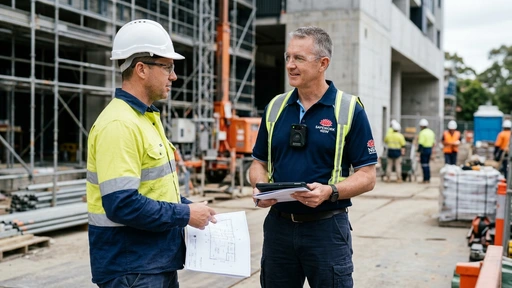
For newer workers, this may mean having someone available to demonstrate tasks, observe how work is being performed and provide feedback. It also provides an opportunity to identify misunderstandings before they become unsafe habits.
Simply asking:
“Do you understand?”
may not provide much assurance.
A worker may genuinely believe they understand. They may also be reluctant to admit uncertainty.
A more useful approach might be:
“Can you show me how you would complete this task safely?”
Demonstration can reveal whether someone understands the process, the hazards and the controls expected of them.
Make it easy to ask questions
One of the most important things a workplace can do is create an environment where asking for help is considered normal. Someone who is new to a workplace may not yet know what is considered unusual.
They may be unsure whether something is worth reporting.
They may also hesitate to interrupt an experienced colleague or supervisor.
That makes the way supervisors respond to questions particularly important.
If someone raises a concern and is dismissed with “we’ve always done it this way,” they may be less likely to speak up next time.
By contrast, workplaces that actively encourage questions can identify hazards and misunderstandings earlier. This does not only benefit younger workers. A culture where people feel comfortable saying “I’m not sure”, “something has changed” or “this doesn’t look right” can strengthen safety for everyone.
Buddy systems can help transfer practical knowledge
Some workplace knowledge is difficult to capture in a procedure. Experienced workers often know the small warning signs that come from performing a task repeatedly.
- They know what normal looks like.
- They know where problems tend to occur.
- They know which conditions require extra caution.
Pairing newer workers with experienced colleagues can provide a practical way to transfer that knowledge. A good mentor or buddy can explain why a particular control exists, demonstrate how tasks should be performed and provide someone a new worker can comfortably approach with questions.
The aim is not to have someone permanently watching over a worker. It is to provide structured support while confidence and competence develop.
Exposure deserves particular attention
The findings from the 2026 Australian Worker Exposure Survey are especially relevant because some occupational hazards may not cause an immediate injury.
Exposure to substances such as silica, asbestos and lead can have serious long-term health consequences.
For example, respirable crystalline silica can be generated when materials such as concrete, bricks, tiles and stone are cut, drilled, polished or ground. Safe Work Australia notes that inhaling silica dust can cause serious and potentially fatal diseases, including silicosis and lung cancer. Safe Work Australia
A newer worker may therefore need more than an instruction to “wear the correct PPE.”
They need to understand where the exposure comes from, what controls should be operating, what the limitations of those controls are and what they should do if conditions change.
Building that understanding early can help establish safer habits that remain throughout a person’s career.
Keep training going as responsibilities change
A worker’s safety needs change as their role develops.
- An apprentice may gradually begin working more independently.
- A new employee may move onto different equipment.
- A worker may be promoted into a supervisory role.
- Someone may transfer to another site where the hazards are different.
Each change can introduce risks that the worker has not previously encountered.
Training and competency records can help organisations keep track of formal requirements, but the conversation should go further than simply asking whether a course has been completed.
Organisations should also consider whether workers have had enough practical experience, whether supervision is still required and whether competency has been demonstrated.
Young workers are an investment in the future workforce
Young workers should not be viewed as a safety problem to manage. They are future tradespeople, operators, specialists, supervisors, managers and safety leaders.
The responsibility of today’s workplace is to give them the opportunity to become experienced workers safely.
Good induction provides the foundation.
Good training develops capability.
Good supervision provides support.
And experience, built gradually in an environment where people are encouraged to ask questions and speak up, helps turn knowledge into sound judgement.
The objective is not to keep inexperienced workers away from work.
It is to give them the support they need to become experienced workers without being harmed along the way.
That is not only an investment in the individual worker.
It is an investment in the knowledge, capability and safety culture of the workforce that comes next.