
Organisational Change: Hidden Workplace Safety Risks
Discover how organisational change can introduce hidden WHS risks and why updating risk assessments, procedures and safety controls is essential.

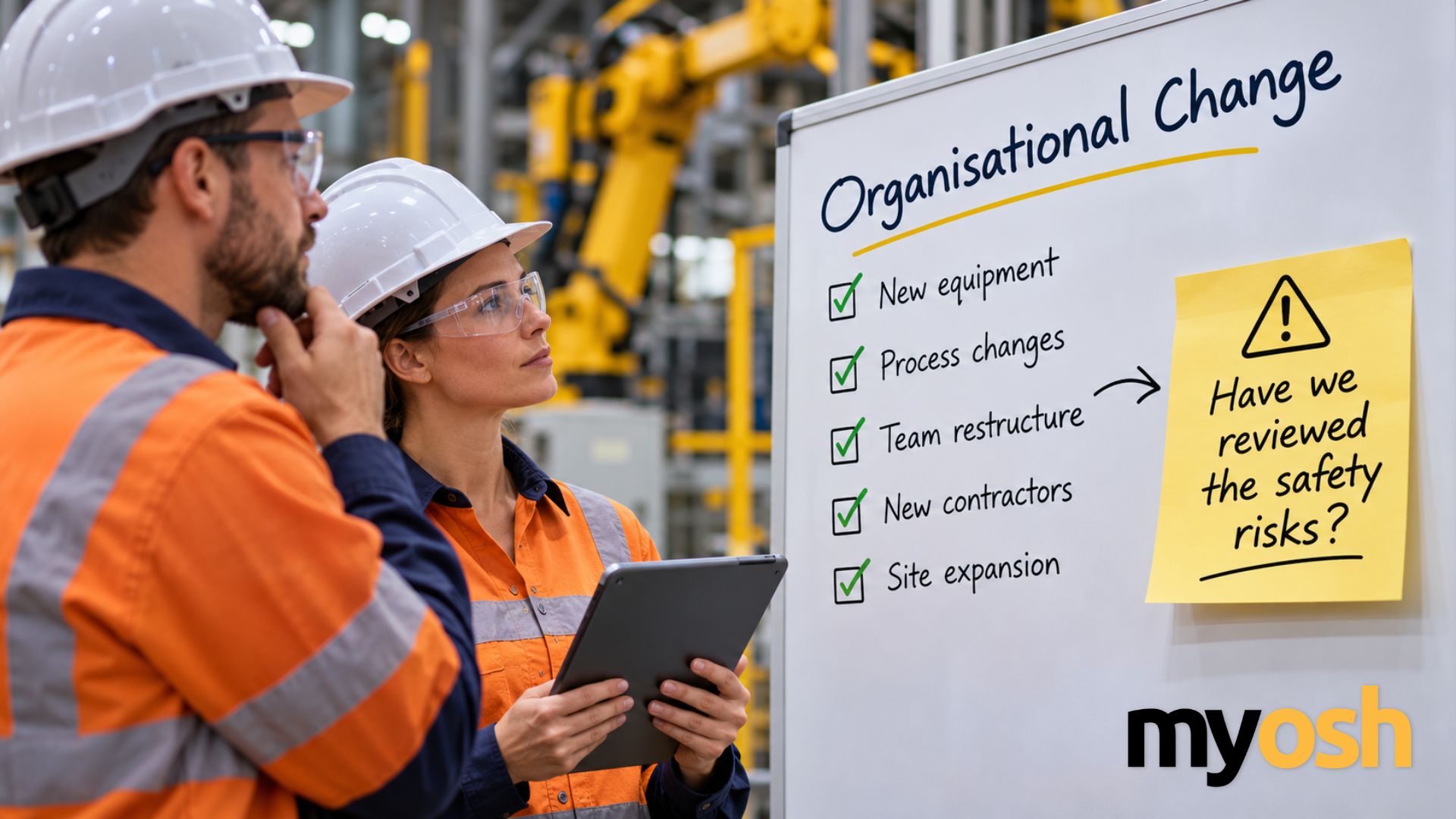
Change is a constant in modern workplaces. Whether it's introducing new technology, restructuring teams, expanding operations or modifying existing processes, organisations are continually adapting to improve efficiency, productivity and performance.
However, while considerable attention is often given to the operational and financial implications of change, the potential impact on workplace health and safety can be overlooked.
Even relatively minor changes can introduce new hazards, alter existing risks or affect the effectiveness of established safety controls. When safety systems, procedures and risk assessments fail to keep pace, organisations may unknowingly expose workers to risks that were previously well managed.
Effective change management is therefore more than an operational consideration. It is an important component of a proactive workplace health and safety (WHS) strategy.
When Everyday Changes Create Unexpected Risks
Organisational change doesn't always involve major restructuring or large-scale projects. Smaller operational adjustments can have equally significant safety implications, particularly when their effects are not fully considered.
Common examples include:
- Introducing new equipment or technology: New machinery, automated systems or digital tools may change how tasks are performed, creating hazards that existing procedures do not adequately address.
- Changing workplace processes: Modifying workflows, production methods or operating procedures can introduce new risks or affect established safety controls.
- Restructuring teams or responsibilities: Changes to reporting lines, staffing levels or job responsibilities can create uncertainty around safety accountability, supervision and competency requirements.
- Engaging new contractors or suppliers: Different work practices, equipment or levels of experience can introduce risks that require additional assessment and coordination.
- Expanding or relocating operations: New facilities, worksites or operational environments may expose workers to unfamiliar hazards.
Individually, these changes may appear routine. However, their cumulative effect can create gaps between how work is actually performed and how safety risks were originally assessed and controlled.
The Danger of Outdated Risk Assessments
Risk assessments are often developed around established operating conditions, equipment, personnel and procedures. When those conditions change, the assumptions underpinning an existing risk assessment may no longer be valid.
Consider a manufacturing facility that introduces new automated equipment to improve production efficiency. Although the machinery may incorporate advanced safety features, its introduction could also change maintenance requirements, worker interactions, isolation procedures and the competencies needed to operate it safely.
If the organisation continues relying on its previous risk assessments and operating procedures, important hazards may remain unidentified.
The same principle applies to organisational changes. A restructure that reduces supervisory capacity or redistributes responsibilities could affect how safety inspections are conducted, incidents are escalated or critical controls are verified.
This highlights why risk management should be treated as an ongoing process rather than a one-time exercise.
Safe Work Australia's Model Code of Practice: How to Manage Work Health and Safety Risks identifies changes to work practices, organisational structures, equipment and workplace environments as circumstances requiring renewed attention to WHS risks.
Regularly reviewing risk assessments and control measures helps organisations determine whether existing safeguards remain appropriate as operating conditions evolve.
When Safety Procedures No Longer Reflect Reality
One of the less visible consequences of organisational change is the gradual disconnect between documented safety procedures and actual workplace practices.
A procedure may have been appropriate when originally developed, but subsequent changes to equipment, staffing or operational processes can make parts of it outdated.
For example, a maintenance procedure may specify isolation steps designed for equipment that has since been modified. Similarly, a contractor induction process may no longer address hazards introduced through recent site changes.
When documented procedures no longer reflect how work is performed, workers may be forced to rely on informal knowledge, assumptions or individual judgement.
Over time, these workarounds can become accepted practices, making it increasingly difficult to identify where existing safety controls are no longer effective.
Maintaining alignment between documented procedures and operational reality requires regular reviews, clear ownership of safety documentation and effective communication between operational teams and WHS personnel.
The Human Impact of Poorly Managed Change
Organisational change can also introduce psychosocial risks. Restructures, new technologies, changing responsibilities and altered working arrangements may create uncertainty, increased workloads or confusion about expectations.
Where changes are poorly communicated or workers are not adequately supported, these pressures can contribute to stress, fatigue and reduced confidence in workplace processes.
Safe Work Australia identifies poor organisational change management as a potential psychosocial hazard, particularly when workplace changes are poorly planned, communicated or supported. Worker consultation plays an important role in managing these risks.
Employees often have firsthand knowledge of how tasks are performed and may recognise practical safety implications that are not immediately apparent during management-level planning.
Engaging workers early, communicating proposed changes clearly and providing appropriate training and support can help organisations identify potential hazards before they become embedded in everyday operations.
Building Safety into the Change Management Process
Rather than addressing safety concerns after changes have been implemented, organisations should integrate WHS considerations into the planning and approval process.
A structured approach can help ensure that potential risks are identified, assessed and controlled before changes affect workplace operations.
1. Identify changes that may affect WHS
Establish a process for recognising operational, organisational or technological changes that could introduce new hazards or alter existing risks.
2. Assess potential safety implications
Consider how the proposed change may affect existing risk assessments, critical controls, procedures, worker competencies and supervision requirements.
3. Consult affected workers
Involve workers, supervisors and relevant stakeholders in identifying hazards and evaluating how the proposed changes may affect their activities.
4. Update procedures and control measures
Where necessary, revise risk assessments, operating procedures, training requirements and other safety documentation before implementation.
5. Assign responsibilities and track actions
Ensure that required safety improvements have clear owners, completion dates and appropriate verification processes.
6. Monitor the effectiveness of the change
After implementation, review whether the updated controls are working as intended and whether any unexpected hazards have emerged.
By incorporating these activities into everyday change management, organisations can reduce the likelihood of important safety considerations being overlooked.
Why Visibility Matters Across the Organisation
Managing the safety implications of change becomes increasingly challenging as organisations grow.
Larger businesses may operate across multiple locations, departments and operational environments, with different teams responsible for risk assessments, procedures, training and corrective actions. Without a coordinated approach, important information can become fragmented.
For example, an operational team may implement a new process without notifying the personnel responsible for maintaining associated risk assessments or training records. As a result, some safety documentation may remain unchanged even after the new process becomes operational.
Digital WHS management systems can help address these challenges by providing greater visibility across risk management activities.
Centralised risk registers, documented assessments, assigned corrective actions and accessible safety records can support more consistent management of changing workplace risks. They can also help organisations track outstanding actions, monitor progress and maintain accountability as operational conditions evolve.
However, technology alone cannot ensure effective change management. Clear responsibilities, worker consultation and a proactive safety culture remain essential.
Keeping Safety Aligned with Change
Organisational change is often necessary for growth, innovation and improved performance. However, even well-intentioned changes can create unintended safety consequences when their potential impacts are not adequately assessed.
The challenge for organisations is not to avoid change, but to ensure that their safety management practices evolve alongside it.
By regularly reviewing risks, maintaining accurate procedures, consulting workers and monitoring the effectiveness of control measures, businesses can identify emerging hazards before they lead to incidents.
Ultimately, effective change management requires organisations to ask not only whether a proposed change will improve operations, but also how it might affect the health and safety of the people involved.
As workplaces evolve, their safety systems must evolve with them.
