
From Reporting Incidents to Recognising Patterns: Where AI Can Make a Difference in Workplace Safety
Discover how AI can help safety teams identify patterns, improve incident investigations and turn workplace safety data into actionable insights.

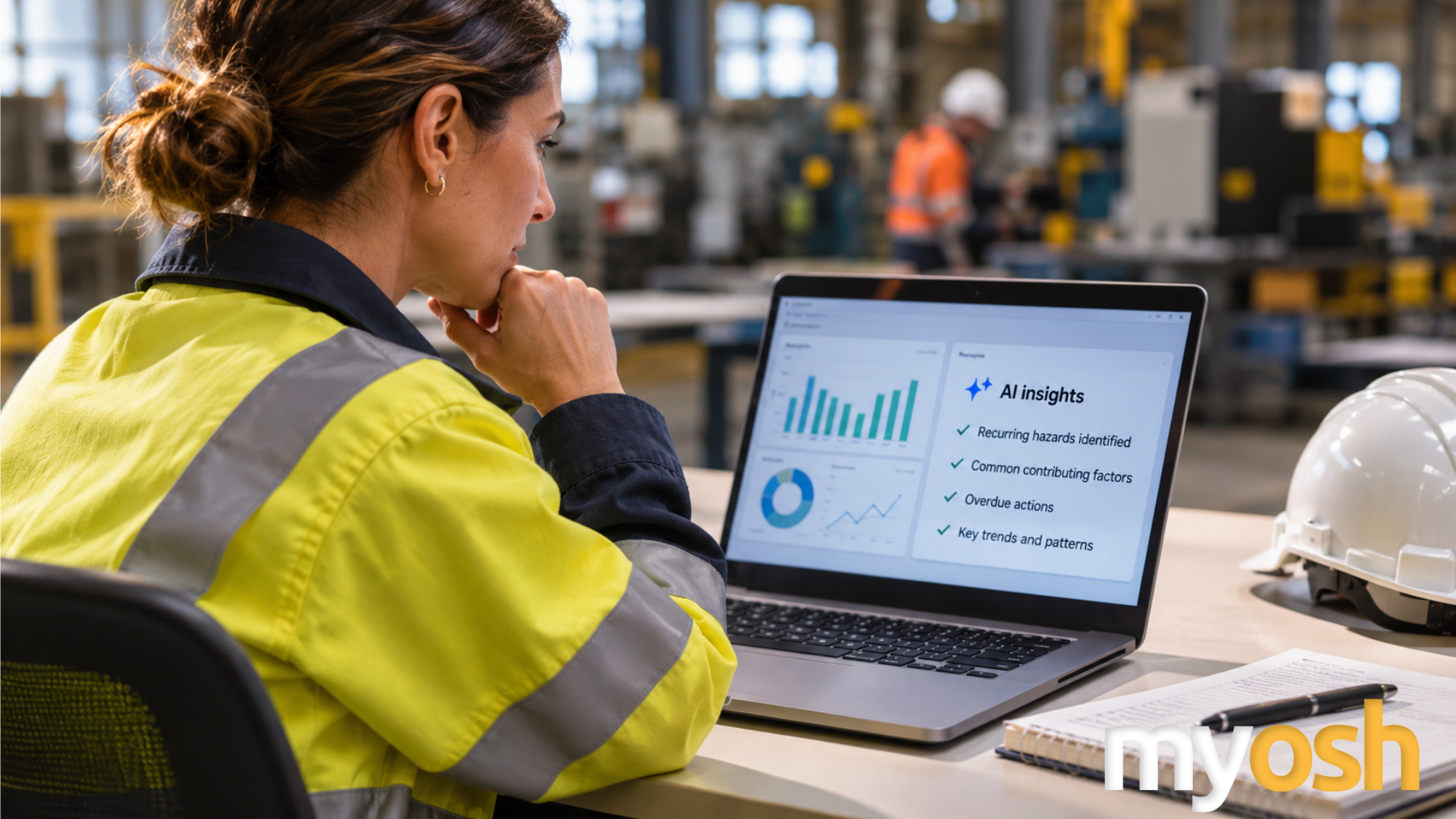
Workplace safety teams collect enormous amounts of information. Incident reports, hazard observations, inspections, risk assessments and corrective actions all contribute to an organisation's understanding of workplace risk. But collecting information is only part of the challenge.
The real value lies in understanding what that information is telling us, recognising emerging risks and using those insights to prevent incidents before they happen.
For many organisations, this is easier said than done. Safety professionals often spend significant time reviewing individual records, preparing reports and following up on actions. Meanwhile, valuable insights may remain hidden across hundreds or even thousands of records.
Artificial intelligence (AI) presents an opportunity to change that.
Rather than simply making existing administrative processes faster, AI has the potential to help organisations make better use of the safety information they already collect.
The challenge isn't a lack of safety data
Most organisations have established processes for reporting incidents, identifying hazards and conducting workplace inspections. Every report adds another piece of information about how work is performed, where risks exist and how effectively controls are operating.
However, these records are often reviewed individually.
An incident investigation may focus on establishing what happened and identifying corrective actions. An inspection may highlight an issue that needs attention. A hazard report may trigger an immediate response.
Each process serves an important purpose. But what happens when similar issues appear across different locations, departments or reporting periods?
Consider a manufacturing organisation that records several seemingly unrelated events:
- A worker reports difficulty following an established operating procedure.
- An inspection identifies a missing machine guard.
- A near-miss report highlights an unsafe maintenance practice.
- A corrective action relating to equipment isolation remains overdue.
Individually, these records may appear manageable.
Viewed together, however, they could indicate a broader weakness in operational controls, maintenance practices or procedural compliance.
Identifying these connections manually can be time-consuming, particularly in large organisations managing substantial volumes of safety information.
This is where AI-assisted analysis can offer a different perspective.
Moving from individual reports to meaningful patterns
Traditional safety reporting often focuses on measurable activities: incidents recorded, inspections completed, hazards identified and corrective actions closed. While these measures are useful, they don't always explain why problems continue to occur or whether underlying risks are being effectively managed.
AI can assist by analysing information across multiple records and identifying recurring themes, inconsistencies and potential relationships.
For example, safety teams could use AI to examine incident and hazard records and explore questions such as:
- Are similar incidents occurring across multiple sites?
- Which hazards are repeatedly reported despite corrective actions?
- Are certain activities associated with recurring procedural failures?
- Do investigation findings indicate common contributing factors?
- Are there patterns in overdue actions that warrant closer attention?
The objective is not to replace existing reporting processes. It is to extract greater value from them. AI-generated observations can provide safety professionals with a starting point for deeper investigation, helping them focus on areas that may require additional attention.
Importantly, identifying a pattern does not automatically establish its cause. Findings still need to be examined in the context of actual workplace conditions.
Improving the quality of incident investigations
Incident investigations play a critical role in identifying contributing factors and preventing recurrence. However, the quality of an investigation often depends on the information available, the questions asked and the consistency of the investigation process.
An incomplete report may overlook important circumstances. Inconsistent classifications can make it difficult to compare incidents. And where information is missing, investigators may need to spend additional time seeking clarification.
AI can support this process by reviewing recorded information and identifying areas that may warrant further investigation.
For example, an AI-assisted review might identify that an incident has been classified as a near miss, despite the report describing an injury. It could highlight missing information about equipment involved, suggest questions about the sequence of events or identify inconsistencies between different sections of a report.
For more complex incidents, AI may also assist investigators in developing relevant questions based on the circumstances described. These applications can help improve the completeness and consistency of investigation records.
However, AI-generated questions and observations should support, not replace, established investigation methodologies, evidence gathering or professional judgement.
Helping safety teams spend more time on prevention
One of the most promising opportunities for AI is reducing the administrative effort associated with routine safety activities. Safety professionals regularly prepare documentation, review records, summarise findings and develop reports for operational teams and management.
These activities are necessary, but they can also take time away from engaging with workers, verifying controls and addressing risks in the field.
AI can potentially assist with tasks such as:
- Summarising lengthy incident or inspection records.
- Identifying missing or inconsistent information in reports.
- Suggesting relevant investigation questions.
- Preparing initial drafts of safety documentation.
- Analysing recurring themes across selected records.
- Helping communicate findings to different audiences.
For example, a safety manager preparing a monthly operational review may be able to use AI to identify recurring issues across hazard reports and corrective actions, rather than manually reviewing every record to prepare an initial summary.
The resulting analysis can then be checked, refined and used to inform discussions with operational leaders.
The benefit isn't simply producing information more quickly. It is creating opportunities for safety teams to devote more attention to interpreting findings and implementing improvements.
Bringing AI into everyday safety workflows
As AI becomes more accessible, an important consideration for organisations is how it fits into existing safety management processes. Introducing a separate AI tool may offer useful capabilities, but it can also require employees to transfer information between systems or work outside established processes.
An alternative approach is to incorporate AI into the tools safety professionals already use.
For example, myosh is integrating AI capabilities into its workplace health and safety management platform to support activities such as analysing selected safety records, reviewing incident information, assisting with form completion and developing Bowtie risk assessments.
These capabilities are designed to work alongside existing safety management processes rather than requiring organisations to create entirely new workflows.
AI-assisted record analysis can help safety teams explore patterns across information already captured in the system. AI Action Buttons can support users with specific tasks within forms, such as suggesting investigation questions or identifying information that may be missing.
AI can also assist with the preparation and review of Bowtie risk assessments, providing a starting point for examining hazards, causes, consequences and controls.
In each case, the purpose is to support the people responsible for managing safety, not to automate their judgement.
The wider opportunity is to make safety information more useful at the point where decisions are being made.
AI is a tool, not a substitute for professional judgement
Despite its potential, AI is not without limitations.
An AI system can identify patterns in available information, but it may not understand the full context of a particular workplace.
It may not know that equipment has recently been modified, that a procedure is being updated or that unusual operating conditions affected an incident.
AI-generated information can also be incomplete, inaccurate or misleading.
For this reason, human oversight remains essential, particularly when assessing serious hazards, reviewing critical controls or determining corrective actions.
Organisations considering AI in safety management should establish clear expectations about how the technology is used.
This includes ensuring that:
- AI-generated findings are reviewed by appropriately qualified personnel.
- Recommendations are validated against workplace conditions and available evidence.
- Sensitive information is handled according to organisational privacy and security requirements.
- Employees understand the limitations of AI-generated outputs.
- Final safety decisions remain with accountable people.
The goal should be to combine AI's ability to process and organise information with the experience, judgement and practical knowledge of safety professionals.
From reactive reporting to more informed prevention
Workplace safety management has long relied on learning from incidents, understanding hazards and implementing controls to prevent harm. AI does not change these fundamental responsibilities. What it may change is how effectively organisations can use the information generated through everyday safety activities.
A collection of incident reports can become an opportunity to explore recurring contributing factors. Inspection results can help highlight patterns in control performance. Corrective action records can provide insight into whether problems are being addressed consistently.
These insights do not prevent incidents on their own. They must be followed by investigation, engagement with workers, decisions about controls and effective implementation.
But by helping safety teams recognise patterns and identify questions worth exploring, AI can contribute to a more informed and proactive approach to risk management.
The future of AI in workplace safety isn't about replacing safety professionals with technology. It's about giving them better ways to understand risk, ask the right questions and act on the information already available to them.
And sometimes, the most valuable safety insight isn't found in a new report. It's hidden in the information an organisation already has.
myosh AI is built into records, forms, dashboards, and Bowties, so you can review information faster and make better-informed decisions. Explore more: https://www.myosh.com/ai
